

Last Modified: 10/31/2025
Web Resource Guide: Content
Content is an important aspect of any website, whether you are starting a new site or updating a current site. Target audiences for EHDI sites include families, healthcare providers, and interventionists. It is important that information addresses the following aspects of EHDI: screening, diagnosis, early intervention (including the importance of early language development and audiological management), family support, and surveillance. Periodically evaluating audiences and content helps to determine what content is beneficial. All content should have the following characteristics:
- Easy to Find: Important Information is accessible within three clicks from main page
- No spelling or grammatical errors: Content has been reviewed by several partners
- Up to date and current: Information is regularly checked to ensure it reflects current information and technology
- Clear and easy to understand: Reading level is appropriate and free of unnecessary jargon while providing desired information
- Organized: The most important information should appear first on the page, with the option to get more detail if needed
- Validated: Key stakeholders have reviewed and verified content. Stakeholders include subject matter experts such as representatives from the state chapter office of the American Academy of Pediatrics, the state Academy of Audiology, Early Intervention staff, or schools for the deaf and hard of hearing
Content Resources
Following these guidelines will give your site a robust amount of content. Other resources you can use to determine appropriate content include:
- Talking with stakeholders in your area to determine their needs
- Using focus groups
- Looking at EHDI websites to get ideas of what other programs are doing
Critical Content of an EHDI website falls into the following main areas:
- Overview of State’s EHDI program
- Information for various stakeholders
- Information about the EHDI process
Overview of State’s EHDI program
EHDI websites are important in creating a relationship with stakeholders and getting information to the people who need it. An overview of the State’s EHDI program quickly provides the reader with a sense of how the EHDI program is relevant to them. This is particularly important for people who are researching why newborn hearing screening is necessary and for helping them to identify the next steps in the process. There are many websites about hearing screening on the web, and people need to know they can trust your site. Establish credibility of your organization by providing:
- A description of your State’s EHDI Program which includes:
- A mission statement that defines “EHDI” (Early Hearing Detection and Intervention)
- A description of “1-3-6” in association with the EHDI process
- Information pertaining to the history or law/mandates for EHDI in your state
- An explanation of why screening infants is important
- Contact information for the EHDI program coordinator, which should include TTY information and a contact for families who speak a language other than English
Viewer confidence in the site’s content is also increased when state who your program is associated or partnered with. Include associations or use the logos (with permission) of well known groups such as the American Association of Pediatrics on your site. Also consider prominently stating the purpose of your website so that readers can quickly assess the site’s content and determine whether or not it pertains to them.
Homepage: Overview of Program
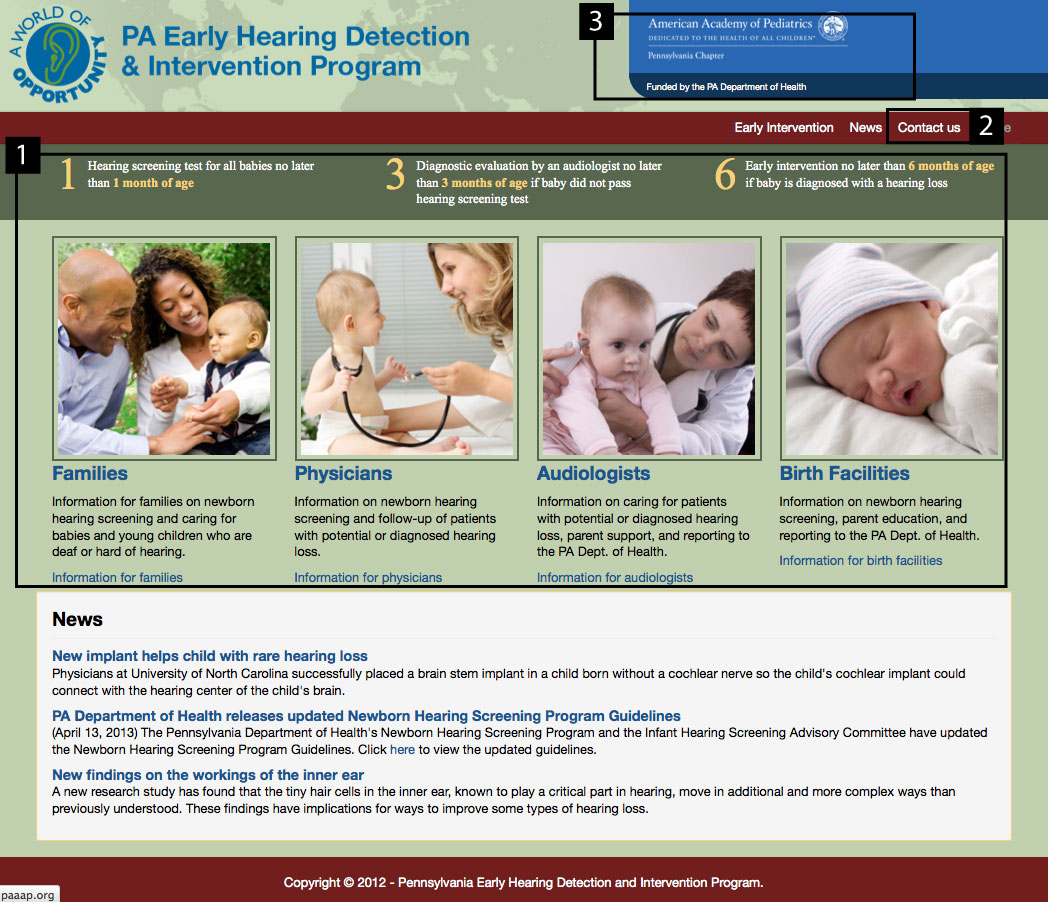
Figure 1.1a
Homepages set the tone of a website. The Pennsylvania EHDI site establishes their credibility with the following content on their homepage (Figure 1.1a):
- Describes “1-3-6” and states the purpose of their website.
- Remember 1-3-6: Hearing screening test for all babies by 1 month of age, diagnostic evaluation by an audiologist no later than3 months of age if baby did not pass hearing screening test, early intervention by6 months of age if baby is diagnosed with a hearing loss.
- The website lists each section for the appropriate stakeholder and provides a brief description of what is included.
- Link to PA EHDI Program Contact. Provides contact information and phone numbers. The contact page also contains a form to request more information or to make comments.
- Uses American Association of Pediatrics, Pennsylvania Chapter logo and states that they are funded by the Pennsylvania Dept. of Health.
Information for various stakeholders
EHDI websites are important for a wide array of users–physicians, audiologists, families, and early interventionists. Content should be written and formatted for the specific target audience. Content geared towards professionals can be more technically oriented, while content for families should be written for people with basic literacy skills. If possible, content should be provided in multiple languages to ensure that families whose first language is not English can also benefit from the information. Review demographics in your state to determine which languages are appropriate to include on your site.
Likely information that is relevant for these various stakeholder groups are identified below:
Families
Include relevant information for parents, guardians, and/or caregivers:
- Importance of having a child’s hearing screening completed before 1 month of age
- What to do if you don’t know your child’s newborn hearing screening results
- Simple explanation of screening result terms, such as “pass,” “fail,” “refer,” or “incomplete”
- What to do if you have concerns about your child’s hearing
- Importance of continued hearing screenings for your child, throughout their childhood
- Way to email questions and/or links to access resources (pay for services, parent support groups, technology)
- Information on where to find an audiologist
- Information and resources in other languages: PDF’s, brochures, and web content
Healthcare providers
Include relevant information for hospital providers/midwives, medical homes/primary care doctors, and audiologists/ENTs:
- The role of providers in conducting screening and/or following up on screening
- The role of providers in reporting results to EHDI and reporting procedures
- How to deliver and explain hearing screening/diagnostic results to families
- Referral sources for rescreening, diagnostic evaluations, and early intervention, including contact information for these services
Interventionists
Include relevant information for Part C Early Interventionists, Schools for the Deaf, private therapists, and audiologists:
- The role of interventionists in screening and diagnostic evaluations–how to partner with Part C
- The role of providers in reporting results to EHDI–how to do it
- The importance of audiological follow-up–how to partner with audiologists
- Contact information/links for families for various agencies and pediatric audiologists in the community
- Information about EI resources for children who are Deaf/hard of hearing: Family organizations, resource guides to help families learn about communication options, etc.
Finding Content for Stakeholders
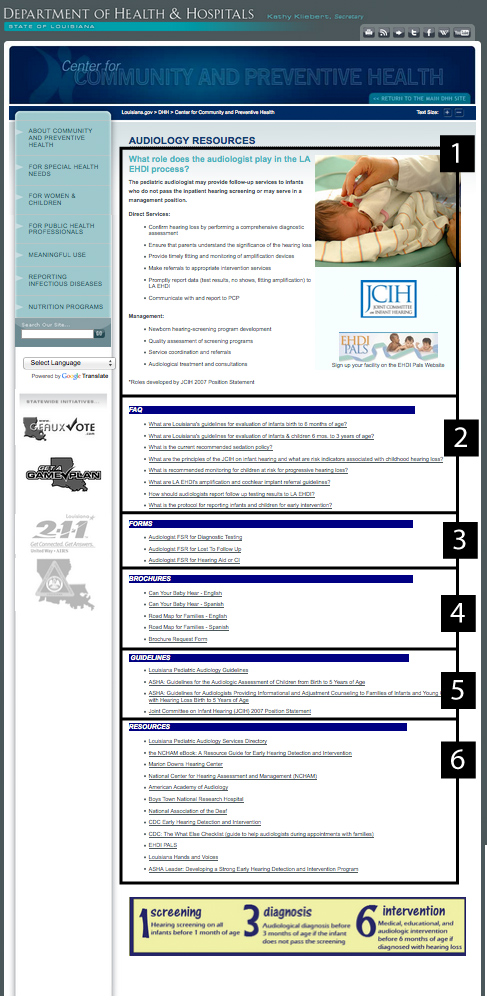
Figure 1.2a
Louisiana's EHDI website provides information for each of its stakeholders and each section is organized in a similar fashion.
- The page offers a description about the stakeholder's role in the Louisiana EHDI process.
The rest of the sections provide links to other webpages and resources for the following sections per each stakeholder:
- Frequently asked questions (FAQ)
- Forms
- Brochures
- Guidelines
- Resources
Providing content in multiple languages
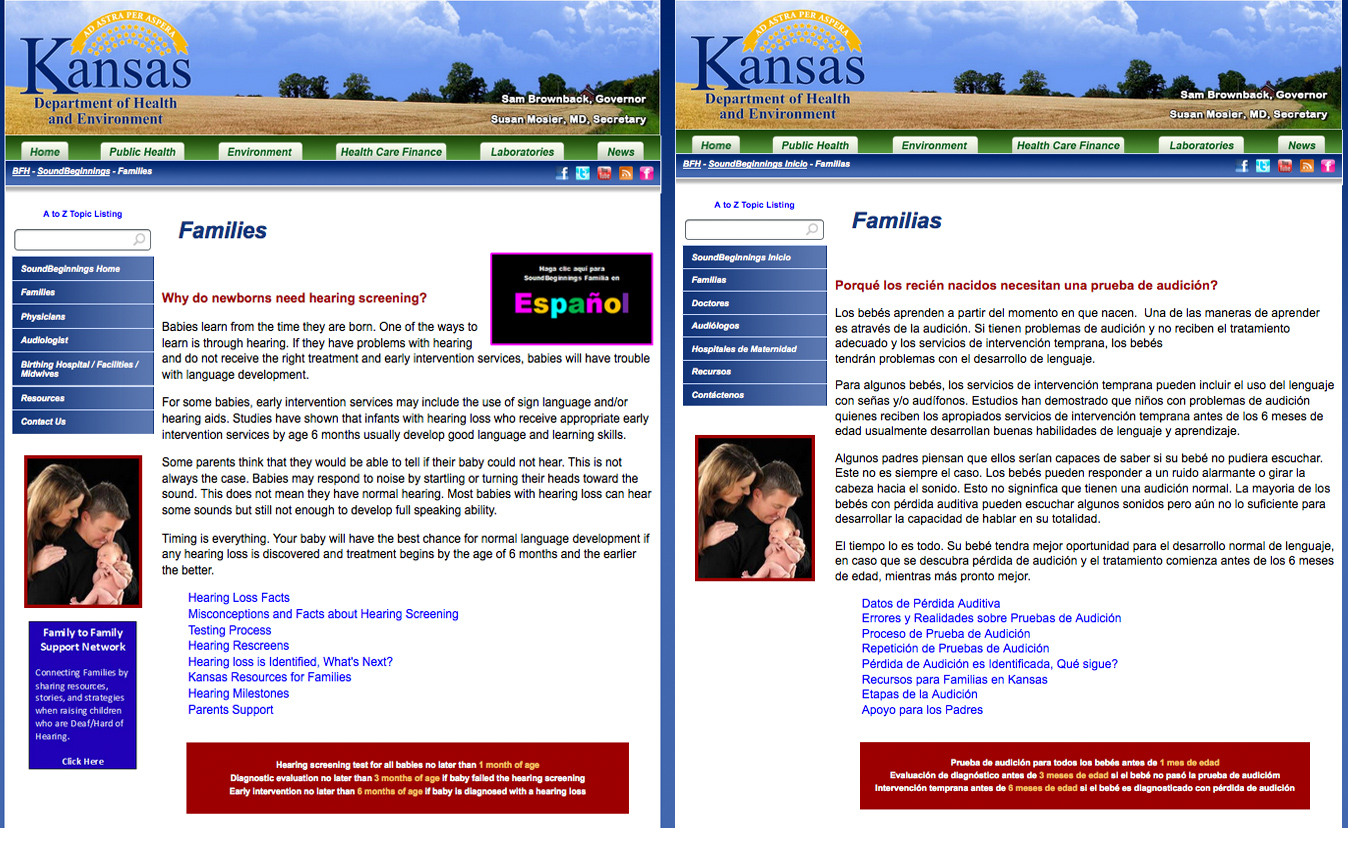
Figure 1.2b
The Kansas State EHDI website provides an English and Spanish version of many of the webpages on their site. (Figure 1.2b)
After clicking in the Español link in the top right corner of the "families" page, the majority of the website pages are translated into Spanish. Going back to the home page returns to the English version webpages. Kansas provides a resource guide in Spanish as well.
Virginia's EHDI website provides two pages for families: one in English (Information for Families) and one in Spanish (Informacion para los Padres). Both pages provide resources such as videos, posters, and PDFs in the appropriate language.
Information about the EHDI process
Screening, diagnosis, intervention, family support, and surveillance information are vital components of the EHDI process. Content needs be written in clear, simple language because all stakeholders are considered part of the target audience. Essential information should be provided to answer “who, what, where, when, and why” questions.
Key pieces of information that sufficiently describe each process of early hearing detection and intervention:
Screening
- Explain why screening is important for children
- Define screening and rescreening
- Describe when hearing should be screened and rescreened
- Describe who conducts screenings
- Provide information on where to obtain a screening
Diagnosis
- Define diagnostic evaluation
- Describe when diagnostic evaluation is needed
- Describe who conducts diagnostic evaluations
- Provide information on where to obtain diagnostic evaluation
- Provide information about how it can be paid for (insurance, public programs)
Early intervention
- Define early intervention
- Identify who to contact (i.e. early intervention services)
- Provide information on a variety of communication options
Audiological Intervention
- Describe hearing assistive devices (hearing aids, cochlear implants)
- Importance of consistent, routine monitoring of assistive devices
Family Support
- Define family support
- Discuss why it’s important
- Provide information on family support organizations and other resources
Surveillance
- Discuss the role of the state EHDI program in surveillance to ensure children are screened
- Discuss the role of health care providers in reporting to the EHDI program
Surveillance Systems
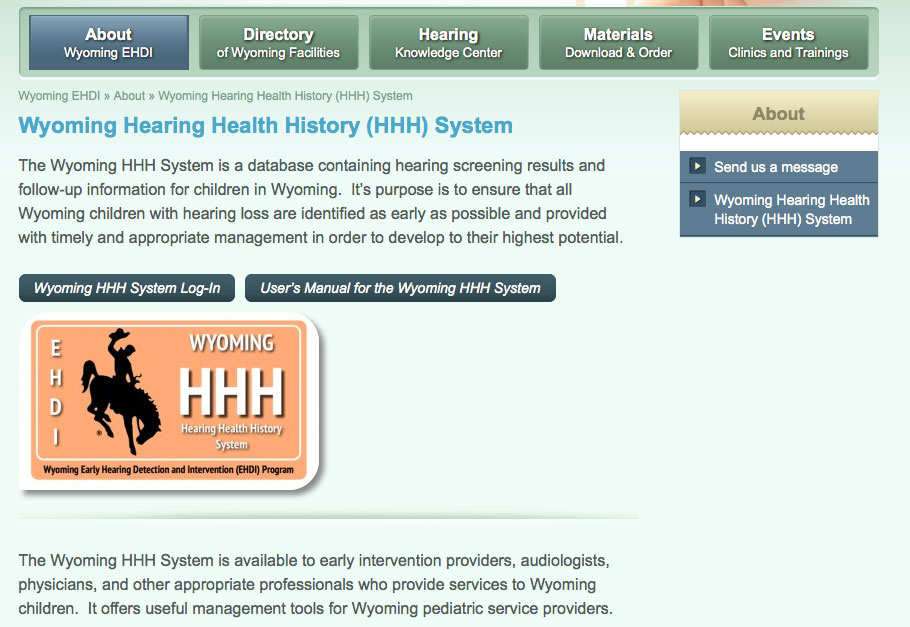
Figure 1.3a
To ensure appropriate screening, follow-up and referral processes Wyoming created an EHDI Database web application. The Wyoming HHH System is a database is used to record hearing screening results and follow-up information for children in Wyoming that is available to the appropriate providers.
Information for the EHDI process
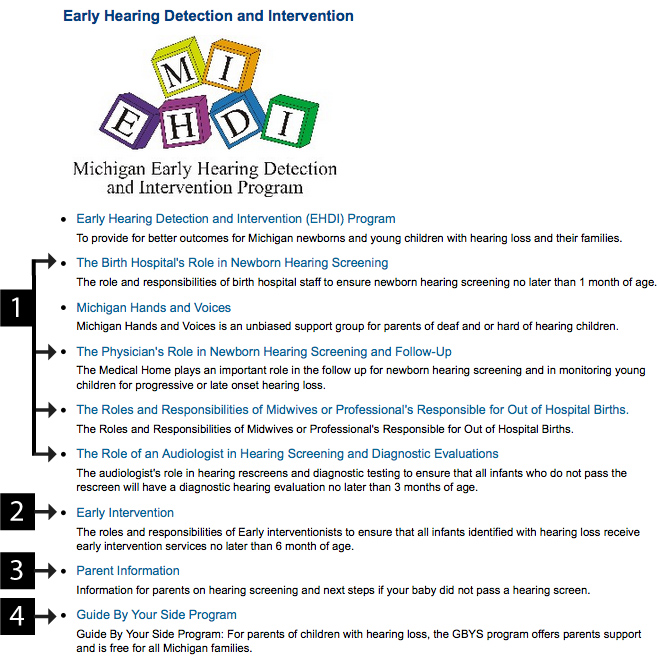
Figure 1.3b
Michigan EHDI process (Figure 1.3b) is presented on the following pages.
- Provider Roles for Newborn Hearing Screening & Diagnostic Evaluations: Describes information needed for Hospitals, Physicians, and Midwives who conduct hearing screenings and for Audiologist who also do Diagnostic Evaluations.
- Early intervention: Provides contact information and links related to early intervention.
- Parent Information: Provides information on the types of test and what families can do. List of facilities that preform screening and/or diagnostic hearing test.
- Guide by Your Side: Is a support program for families who have infants or young children who are deaf or hard of hearing.
Each page contains links to brochures for stakeholders, reporting information and forms for providers, and other information and resources.
Finding Providers
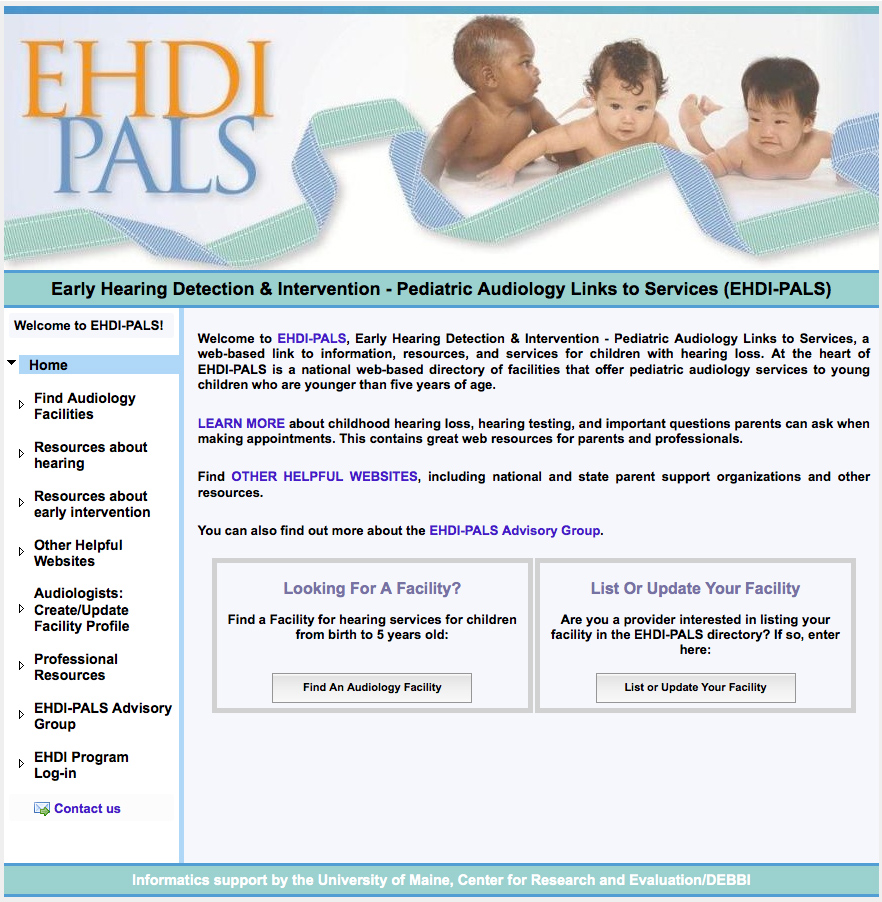
Figure 1.3c
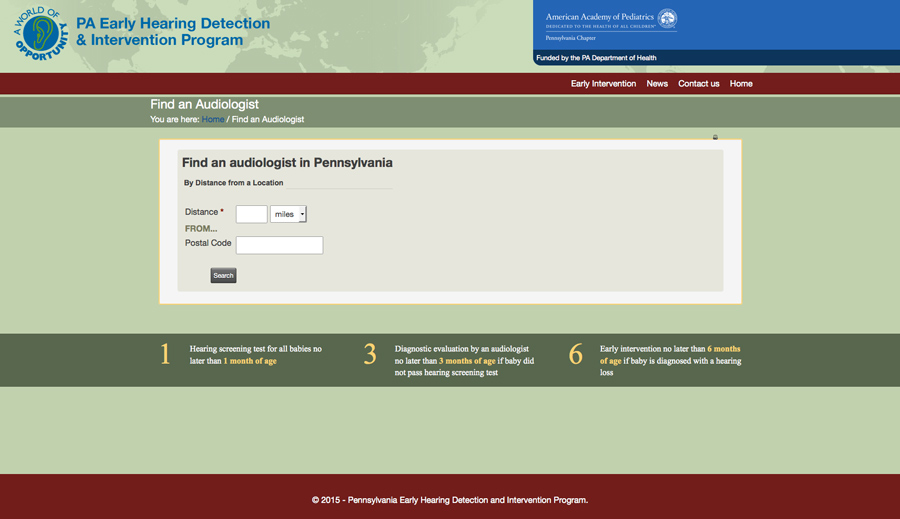
Figure 1.3d
It is important to keep up-to-date information for health care providers, audiologists, and interventionist. Some EHDI sites have PDFs that list their facilities which provide these services while other sites either use the EHDI Pals or have created an interactive application to search for providers.
The EHDI-Pediatric Audiology Links to Services (PALS) is a web-based directory and search engine designed to help parents, hospital personnel, and referring physicians find the nearest clinic that can provide the type of hearing service each child needs.
PA EHDI website allows its users to access Finding an Audiologist information with a distance from a zip code.